 English
 简体中文
 한국어

Start here
Four notes most engineers read first.
All application notes
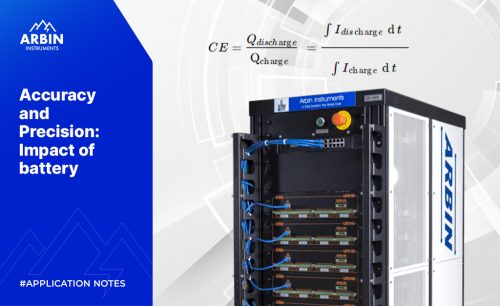
Accuracy and Precision: Impact of battery tester’s accuracy
In the previous article, we introduced the concepts of accuracy and precision, along with a brief overview of their influence on battery testing. In this article, we will take a deeper look at the impact of accuracy. We will take an example about the impact on capacity measurement and Coulombic Efficiency measurement. As we all […]

Accuracy and precision: Overview
1. Introduction Battery testing is fundamentally a measurement task. Whether evaluating cycle life, coulombic efficiency, voltage response, or degradation mechanisms, the quality of conclusions depends on the quality of the data. Two concepts govern data integrity in any battery test system: accuracy and precision. Although often mentioned together, they describe different aspects of measurement performance. […]
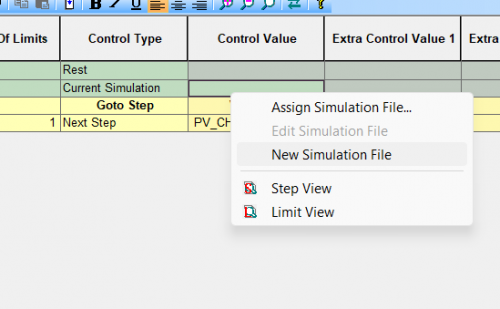
Test EV Battery pack with real-time drive condition using Simulation Control types
Information and Instructions for using the Simulation control types. 1. General Description Simulation refers to the ability to input data collected from a non-formulated dynamic regime (i.e. other than Constant Current, Constant Voltage, Constant Power, Ramp, Staircase, Pulse, or Formula) as a control function. There are three control types: 1. Current Simulation – uses a […]

How to run cyclic voltammetry on three-electrode(3E) cell using Arbin Tester
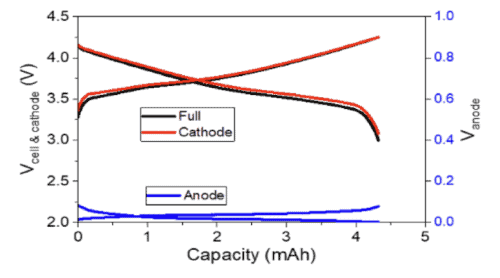
I. Introduction to 3E cell In a battery with 2 electrode, when you measure the battery voltage, you measure the potential difference between the cathode and anode of the battery. In this case, you only see the total difference in potentials and do not know how much each electrode contribute to this difference. You would […]

How to run cyclic voltammetry(CV) using Arbin Tester
Arbin continues to power innovation in many areas of battery research, including electrochemical experiments such as cyclic voltammetry (CV). Arbin equipment is designed to perform electrochemical experiments with the precise circuitry required for linear voltage ramps, while the MITS software gives the user a wide variety of options to create test schedule profiles. Understanding the […]

Enhancing Battery Testing Safety with a Door Switch Interlock System
I. Purpose and Applicability Battery testing—whether for electric vehicles, consumer electronics, or industrial systems—demands strict safety protocols. One often overlooked but critical element in test chamber safety is the door switch interlock system. This simple yet powerful mechanism helps prevent injuries, equipment damage, and test data corruption. In this article, we’ll explore how door switch […]

Integration of Arbin Instruments with Gamry Potentiostats for High-Frequency EIS up to 2 MHz
According to the standard specifications published by Arbin, integrating a Gamry device with an Arbin system typically limits the device’s original frequency capability from 2 MHz down to 100 kHz. However, in this article, we will introduce a solution that allows the system to retain the full 2 MHz frequency, with some trade-offs to consider. Pre-Conditions for Achieving […]

Integrated Electrochemical Impedance Spectroscopy (EIS) With Arbin Charge/Discharge Channels
Introduction Electrochemical Impedance Spectroscopy (EIS) is a foundational diagnostic technique for evaluating battery health, internal resistance, degradation mechanisms, and electrochemical behavior over time. However, EIS is traditionally limited by hardware complexity and high per-channel cost, making it difficult to scale across large battery test systems. To address these challenges, Arbin Instruments offers an integrated EIS […]

How to Test a Protection Circuit Module (PCM) Using ARBIN EOL
I. Purpose and Scope: The Protection Circuit Module (PCM) is a critical electronic component responsible for monitoring and protecting devices across a wide range of applications—from small consumer electronics to large-scale industrial equipment. Its core function is to ensure battery and device safety by preventing hazardous conditions such as overcharging, over-discharging, overcurrent, and short circuits […]
Auxiliary Voltage Measurement
Introduction The Arbin Auxiliary Voltage Input Module enables precise, high-resolution voltage monitoring for battery testing applications that require measurements beyond the standard I/V channels. Typical use cases include monitoring individual cell or module voltages within a larger pack, measuring reference electrodes in three-electrode cells, or comparing BMS data with directly measured values. Each module supports […]
Auxiliary Temperature Measurement
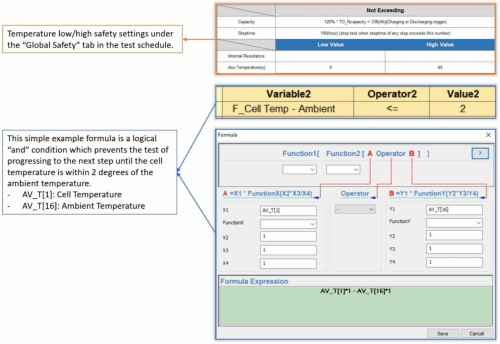
Introduction Battery temperature measurement is essential for evaluating safety, longevity, and performance in modern testing environments. Arbin supports three primary sensor technologies—thermocouples (Type T and K), RTDs (PT100), and thermistors (10kΩ)—each available through dedicated auxiliary input modules. These sensors enable precise temperature control, monitoring, and safety logic throughout battery R&D and production Description Battery testing […]

Constant-C-rate w.r.t. actual capacity, rather than constant current with Arbin cyclers
As we all know, the batteries’ capacity degrade by cycle of charge and discharge. If we set the charge and discharge current of a fixed value, such as 1A, 2A,… the length of each cycle will gradually decreases, simply because the battery’s capacity decreases: Cycle time = (Charge Capacity + Discharge Capacity)/Current Sometimes users want […]
- « Previous
- 1
- 2
- 3
- Next »
Need a method we haven't covered?
Send us your test plan. An Arbin applications engineer will recommend a system and write the first schedule with you.
