 English
  简体中文
简体中文  한국어
한국어  Deutsch
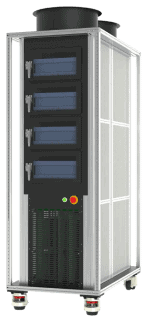

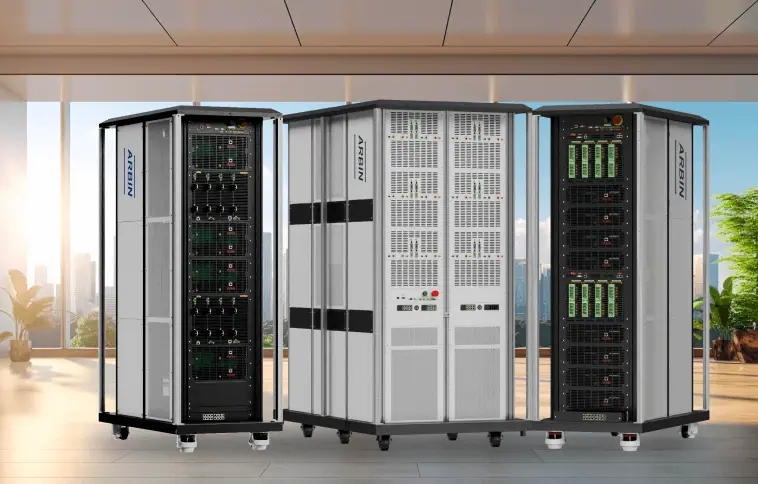




Laboratory Battery Testing System for Module Testing
LBTS-Module Series
High-precision linear cycling and characterization for battery modules from 20 V to 100 V - with four current ranges per channel, 100 ppm precision, true bipolar circuitry, and synchronized BMS and auxiliary data.
Up to 32
Independent channels per chassis
±0.02% / ±0.01%
FSR accuracy / precision
20 - 100V
Module voltage configurations
24-bit
1 part in 16,777,216
Accuracy you can audit
Measurement accuracy held across all voltage and current ranges, with precision published as a separate specification.
Independently verified
Designed and manufactured under an ISO 9001:2015-certified quality system, supported by an ISO/IEC 17025-accredited testing and calibration laboratory.
35 years of instrumentation
Founded 1991. Arbin reinvests 30% of profits into R&D, funding the precision architecture provided with every Arbin test station.
Built for any lab
Scalable channel density in a compact, air-cooled footprint, with open Python and C# API for the automation you already run.
Highlights of the LBTS-Module Series
Four hardware decisions that separate the LBTS-Module from a conventional cycler, and what each one changes about the data you create.
Market Leading Specifications
100 ppm precision, 24-bit resolution
See cell behavior - not tester uncertainty
Voltage and current measurement precision reaches 100 ppm (±0.01% FSR) and 200ppm (±0.02%) accuracy. 24-bit resolution provides fine control and measurement granularity across each current range.
4 Current Ranges
auto-selecting, every channel
Provides the widest range of accurate output and measurement
Arbin was first to put multiple current ranges on a single test channel. Ranges select automatically, including during constant-voltage control, and the rated specification follows them.
Flexible Channel Paralleling
any number of channels
Group channels for more current
Any combination of sequential channels can be connected in parallel to raise the current ceiling for a single test article, rather than choosing from a fixed set of pre-wired banks.
Built-In Safety Features
safety monitoring for every channel
Onboard computation and independent safety
Each channel computes capacity, energy, internal resistance, and efficiency in real time. Voltage, current, and temperature are all checked against safety limits independently of the test control loop.
Applications and Test Methods
Each channel operates as an independent potentiostat and galvanostat, so one chassis covers electrochemical characterization and long-run cycling at the same time.

Module R&D and life-cycle testing
Characterize capacity, efficiency, resistance, degradation, and thermal behavior across repeated cycling and controlled operating conditions.

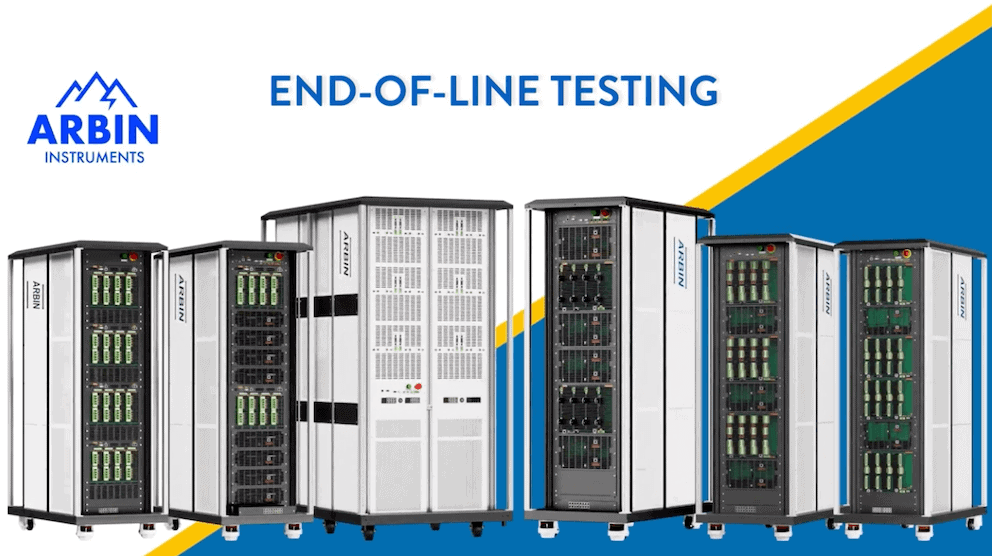
End-of-line and incoming QC
Apply repeatable electrical checks, verify expected module behavior, and combine measured values with BMS signals for pass/fail workflows
BMS communication and validation
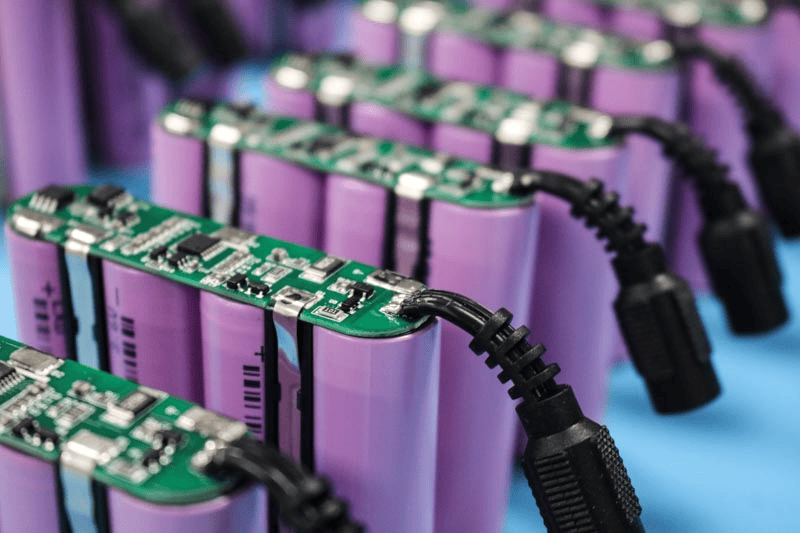
Send and receive CAN 2.0, CAN FD, SMBus/I²C, DBC, and UDS data while comparing reported values with synchronized tester measurements.

Automated and adaptive testing
Drive the tester from your own software. ArbinCTI over TCP/IP plus Lua scripting support BMS emulation, digital twins, and adaptive fast-charge strategies.
Supported Test Methods
Cycling & lifetime
- Charge/discharge cycle life
- DCIR and pulse characterization
- Efficiency and energy analysis
- Self-discharge monitoring
Dynamic simulation
- Drive and duty-cycle profiles
- Current, power, and load control
- Battery simulation
- 10 ms set-point intervals
Production and QC
- Incoming quality control
- Cell-level grading and sorting
- Formation and cell finishing
- End-of-line testing
- Fast-charge optimization
Voltage, Current, and Channel Ranges
Choose the voltage and current architecture around the module. Every listed channel includes four current ranges and independent 4-wire Kelvin measurement.
| Module Voltage | Maximum Current per Channel | Channels per Chassis |
|---|---|---|
| 20 V | 40 A or 80 A | Up to 24 |
| 30 V | 30 A or 60 A | Up to 24 |
| 40 V | 20 A or 40 A | Up to 32 |
| 60 V | 12 A or 25 A | Up to 32 |
| 80 V | 10 A or 20 A | Up to 32 |
| 100 V | Up to 15 A | Up to 16 |
All configurations include four current ranges per channel, 24-bit measurement resolution, ±0.02% FSR accuracy, ±0.01% FSR precision, and independent 4-wire Kelvin measurement. Available channel count depends on the selected current range and whether the configuration operates from 0 V or 4 V.
Comparing systems?
Four hardware parameters decide whether test data is suitable to draw a conclusion from. Here is where the LBTS-Module lands on each, and the question worth putting to every vendor on your shortlist.
Software and Safety
The two questions a lab asks after the specifications check out: can my team actually drive it, and what happens when a cell misbehaves.
MITS Software
MITS scales from basic charge–discharge cycling to complex protocols with nested conditions. Most tests can be built through the menu-driven interface, while Lua scripting and ArbinCTI are available for advanced automation and external control
- ✓ 30+ programmable control types, 90+ meta variables, and up to 9 nested loops
- ✓Up to 127 reusable sub-schedules, so a validated procedure gets called rather than rebuilt
- ✓Adaptive logging raises acquisition rate during transients and state transitions
- ✓DataWatcher queries the SQL database directly — filter by channel, barcode, or cycle count, overlay up to 9 plots
- ✓PostgreSQL, Microsoft SQL Server, and Apache Kafka streaming
- ✓ArbinCTI TCP/IP API plus Lua scripting for BMS emulation and adaptive control

Safety Architecture
Protection is distributed across channel hardware, an independent controller, and step-level software limits. Critical safeguards remain active independently of the test sequence.
- ✓Independent safety monitoring checks voltage, current, and temperature limits without relying on the test control loop
- ✓Hardware E-Stop with all-pole disconnection, plus a dry-contact circuit for facility-wide remote trip
- ✓Hardware voltage clamps on high-current modules; protective fuses in every I/V channel board
- ✓Test Object profiles auto-set thresholds from the cell spec and block a test on reverse polarity
- ✓Behavioral checks flag abnormal rates, voltage excursions, and capacity anomalies
- ✓Tri-color light tower, audible alarms, thermoswitches, variable-speed ventilation


Auxiliaries and Optional Accessories Available to Enhance Testing

Thermal and Environmental
- MZTC - 8 independently controlled mini-chambers, 10°C to 60°C at 20°C ambient
- Holders for coin, cylindrical, pouch, and custom cell formats; up to 8 cells per chamber
- Seamlessly communicate and control third-party temperature chambers in real-time
- Synchronized multi-channel test logic; temperature-driven step control and automated standby modes
- Chamber temperature and humidity logged alongside electrical measurements for complete test traceability

Electrochemical Impedance Spectroscopy
- Integrated Gamry EIS multiplexed across Arbin test channels; eliminates dedicated instruments
- DCIM — Fast DC impedance measurement in under 1 second; enhances standard cycling workflows
- Up to 4 independent Gamry systems enable parallel EIS across many channels simultaneously
- Frequency range: 10 µHz to 100 kHz; full impedance characterization to 10 kHz
- EIS data time-aligned with voltage, current, and temperature for seamless test integration
Auxiliaries
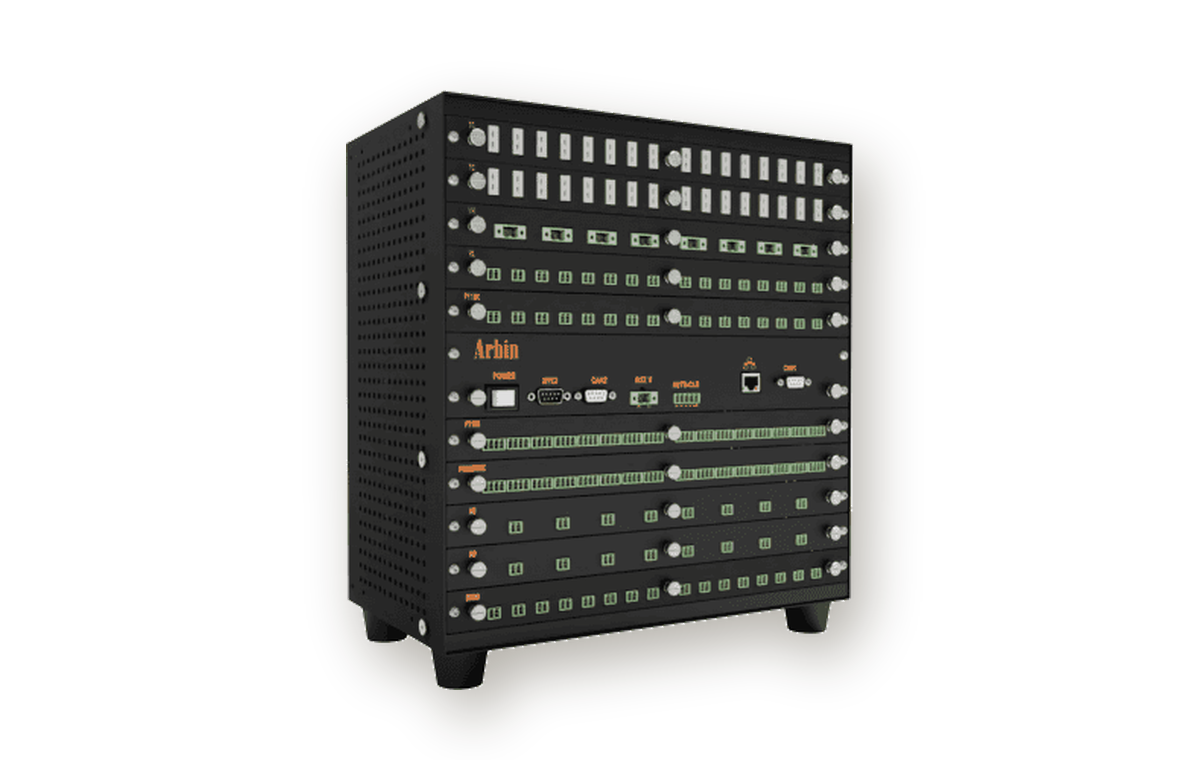
- Temperature sensing — real-time thermal monitoring for chambers and cell surfaces
- Auxiliary voltage inputs — monitor individual cell voltages or reference electrodes within packs
- Analog & Digital I/O — control external devices like pumps, fans, valves, and safety interlocks
- CAN Bus interface — direct communication with Battery Management Systems
- SMBus interface — read and write smart battery registers during testing
- Uninterruptible Power Supply (UPS) — detect power loss and safely pause or resume tests
Build a complete module testing platform
Expand the Arbin platform with BMS communication, cell-voltage and temperature monitoring, environmental control, impedance analysis, calibration, and automation. All options integrate directly with Arbin software for unified test control, safety management, and data acquisition.
Cell Voltage & Temperature
Monitor individual cell voltages and thermocouple, PT100, or PT10k temperature sensors within the module. Use measured values for synchronized logging, safety limits, and real-time test control.
CAN, CAN FD & SMBus
Communicate directly with the module BMS using CAN 2.0, CAN FD, SMBus/I²C, DBC files, and UDS. Compare reported BMS values with synchronized measurements from the Arbin test system.
Chamber & Chiller Control
Control compatible third-party environmental chambers and chillers through Arbin software. Automatically adjust conditions and record environmental data alongside electrical and BMS measurements.
Analog, Digital & Automation I/O
Interface with PLCs, relays, TTL signals, pumps, valves, contactors, safety interlocks, and other external equipment using analog and digital inputs and outputs.
Impedance Analysis
Add integrated Gamry EIS for frequency-domain analysis up to 100 kHz, or use Arbin DCIM for fast DC impedance measurements incorporated directly into a cycling procedure.
Auto Calibration & UPS
Reduce maintenance downtime with Arbin’s optional automated calibration interface. Add UPS protection to support controlled shutdown, data protection, and test recovery during power interruptions.
LBTS-Module or RBT-Module?
Both systems provide independent module testing, precision measurement, BMS integration, and Arbin’s complete software ecosystem. Choose based on whether your priority is linear precision and lower-current measurement or regenerative high-power cycling.
RBT-Module
Designed for higher-current module cycling and long-duration validation where regenerative energy recovery, power capability, and reduced facility energy consumption are the priorities.
Tell us what you're testing
Share the module voltage, continuous and peak current, channel count, duty profile, BMS protocol, and auxiliary measurements. An Arbin sales engineer will recommend the appropriate LBTS-Module configuration and supporting options.
RBT-Cell
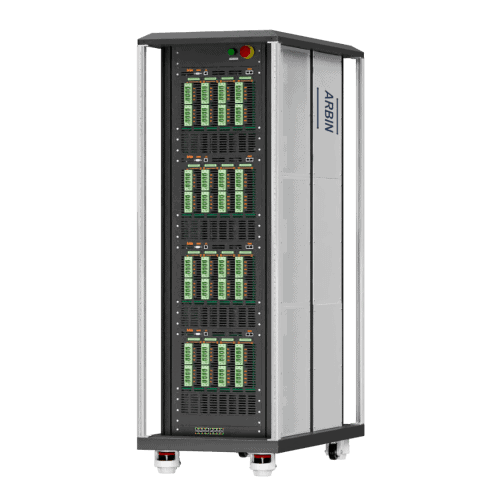
High current cell testing solutions utilizing Arbin's regenerative technology for efficient and reliable testing.
RBT-Module Series
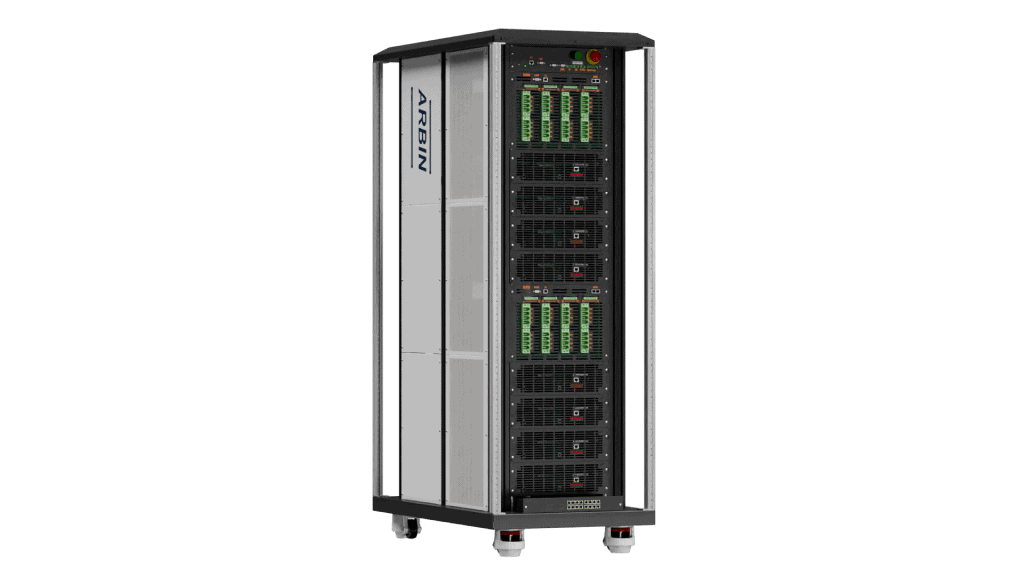
The RBT system ensures high power density and efficiency, while its regenerative circuitry returns power to the grid, making it economical for testing.
