 Deutsch
  English
  简体中文
简体中文  한국어
한국어 





One common reason that measured coulombic efficiency (CE) can appear to exceed 100% is a current measurement offset.
In this example, assume the cycler has a constant negative current offset e. This means the measured current is lower than the true current by e throughout the test.
To simplify the analysis, assume an ideal battery with a true CE of 100%, meaning that its true charge capacity equals its true discharge capacity.
Ideal Case
The figure below shows the ideal case with no current measurement error.
The blue area represents the charging process. The battery is charged using a CCCV profile: constant-current charging at 1 A until the maximum voltage is reached, followed by constant-voltage charging until the current decreases to the cutoff value.
The red area represents the discharge process, which is performed at a constant current of −1 A.
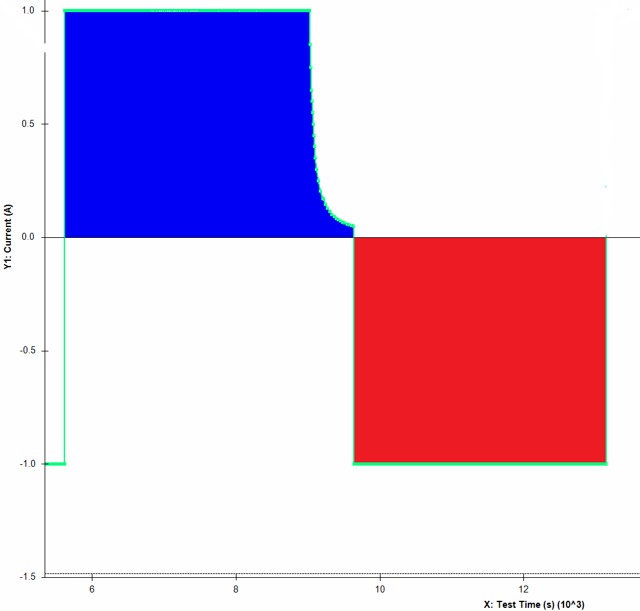
Because the battery is ideal, the true charge capacity and discharge capacity are equal.
Effect of a Constant Current Offset
Now consider a constant negative current offset e.
For a true charging current of +1 A and a true discharge current of −1 A, the measured currents become:
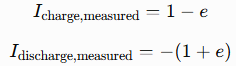
Therefore, the charging current magnitude is underestimated, while the discharge current magnitude is overestimated.
The measured current profile can be visualized by shifting the true current curve downward by e, as shown below.
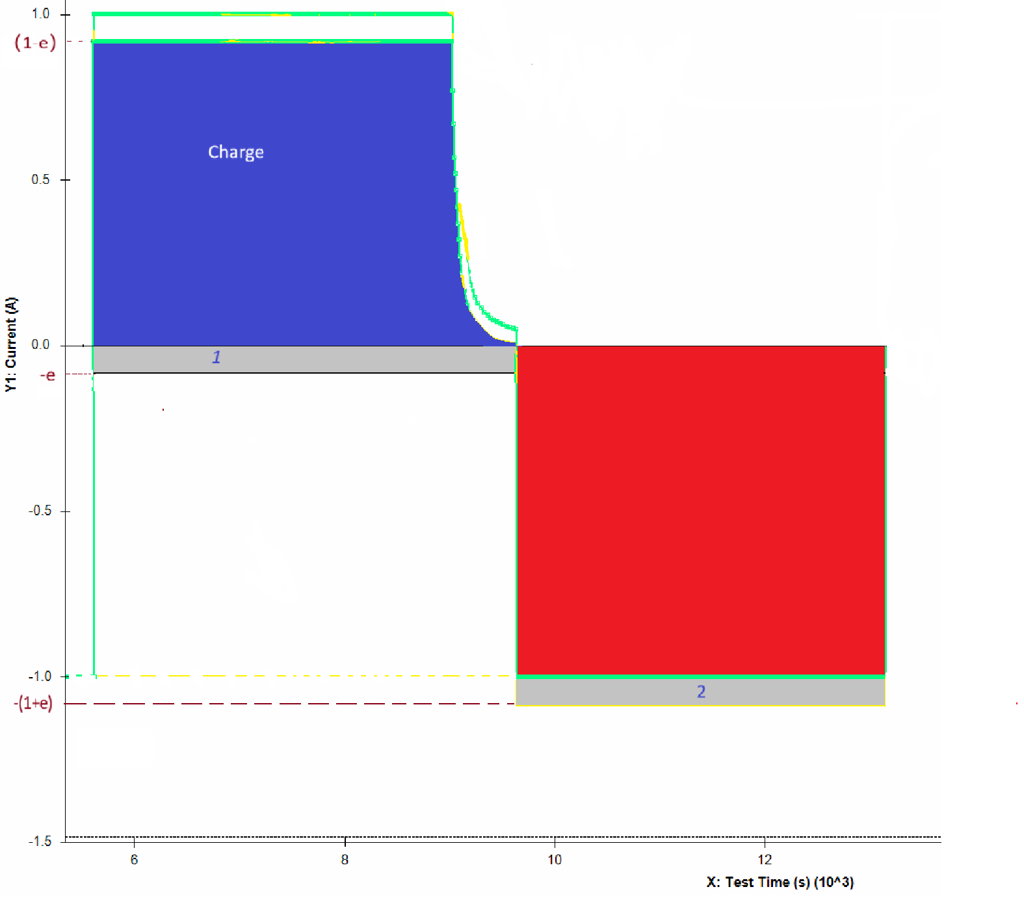
As a result, the cycler calculates a charge capacity that is lower than the true value and a discharge capacity that is higher than the true value. Both effects increase the calculated CE.
In addition, CCCV charging generally takes longer than constant-current discharge because of the CV stage. A constant current offset therefore accumulates over a longer period during charging, making the charge-capacity error slightly larger than the discharge-capacity error.
For a small current offset, the increase in measured CE can be approximated as:
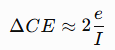
where:
-
e is the current measurement offset;
-
I is the test current magnitude.
This relationship shows that what matters is not only the absolute current offset, but the offset relative to the test current.
Why Current Range Selection Matters
Consider a test performed at 1 A.
If a ±5 A current range is used and the current accuracy is 0.02% of the full-scale span, the full-scale span is 10 A. The maximum current error is therefore approximately 2 mA.
At a 1 A test current, 2 mA corresponds to approximately 0.2%. Based on the approximation above, the measured CE may be shifted upward by roughly 0.4 percentage points.
Therefore:
-
an ideal 100% CE could appear slightly above 100.4%;
-
a true CE of 99.9% could appear around 100.3%.
Now consider the same test using a ±1 A range. With the same 0.02% full-scale specification, the maximum current error is only about 0.4 mA, or 0.04% relative to the 1 A test current.
The corresponding CE shift is approximately 0.08 percentage points, so a true CE of 99.9% would read around 99.98% instead of 100.3%.
Nothing about the battery has changed. The main difference is the current range selected for the measurement.
Why Offset Error Matters More Than Gain Error
The effect described above is caused by a constant current offset.
A negative offset causes the cycler to:
-
underestimate positive charging current;
-
overestimate the magnitude of negative discharge current.
Both effects push the calculated CE upward.
A pure gain error behaves differently. It scales both charge and discharge current by approximately the same factor, so much of the error cancels when the discharge capacity is divided by the charge capacity.
For this reason, when an unexpected CE above 100% is observed, current offset is one of the first measurement errors that should be investigated.
Recommended Corrective Actions
If measured CE is unexpectedly above 100%:
-
Select the lowest appropriate current range that safely covers the test current.
-
Check the zero-current reading for a persistent offset.
-
Verify the channel against its current measurement specification.
-
Recalibrate the channel if necessary.
-
Use consistent current ranges when comparing CE results across channels or systems.

