 简体中文
 English
 한국어

Start here
Four notes most engineers read first.
All application notes
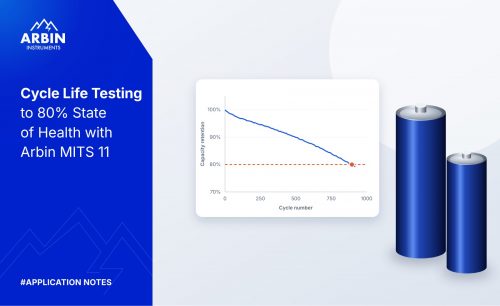
Cycle Life Testing to 80% State of Health
How to program a cycle life test in Arbin MITS 11 that measures the reference capacity, calculates state of health after every cycle, and ends automatically at 80% SoH. Full 11-step schedule.
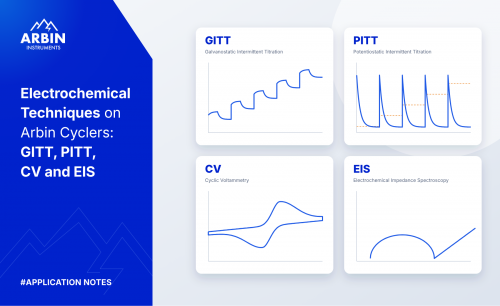
Electrochemical Techniques for Battery Research
What GITT, PITT, cyclic voltammetry and EIS each apply, measure and reveal, and the cycler specifications that decide the result.
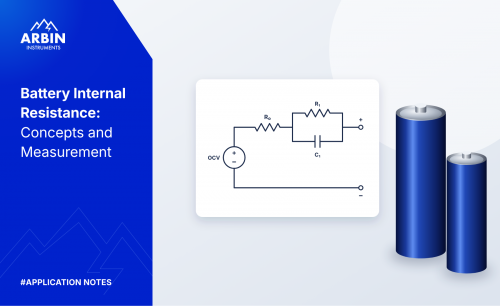
What Is Battery Internal Resistance?
What internal resistance is made of, how ACIR, DCIR and R₀ differ, and how to measure them on Arbin systems.

What Is a Battery Cycler?
How a battery cycler works, the specifications that decide data quality, and how to choose a cell testing system.

Battery Cell Grading and Matching: Why Measurement Precision Determines Pack Performance
Home › Resources › Application Notes › Cell Grading & Matching Application Note AN-025 Battery Cell Grading and Matching: Why Measurement Precision Determines Pack Performance Summary A battery pack is only as good as its weakest cell. In a series string, charging stops when the first cell reaches its upper voltage limit and discharging stops […]
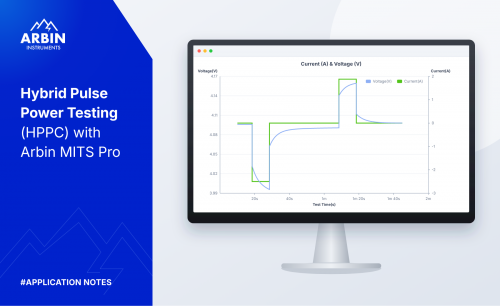
Hybrid Pulse Power Characterization (HPPC) Testing with Arbin MITS Pro
Home › Resources › Application Notes › HPPC Application Note AN-024 Hybrid Pulse Power Characterization (HPPC) Testing with Arbin MITS Pro Summary The Hybrid Pulse Power Characterization (HPPC) test measures the pulse resistance and pulse power capability of a battery across its state-of-charge (SOC) range. This application note describes the HPPC method, the cycler characteristics […]
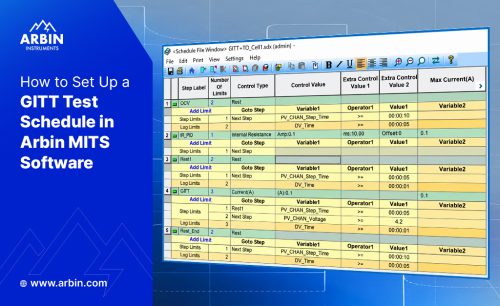
How to Set Up a GITT Test Schedule in Arbin MITS Software
I. Introduction The Galvanostatic Intermittent Titration Technique (GITT) is an electrochemical method commonly used to study ion diffusion behavior and transport kinetics in battery electrode materials. A typical GITT test consists of a sequence of constant-current pulses followed by open-circuit relaxation periods. During each current pulse, the cell voltage changes as the state of charge […]
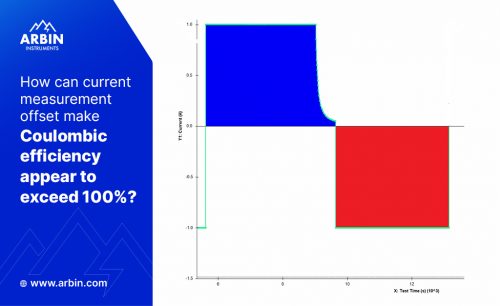
How Can Current Measurement Offset Make Coulombic Efficiency Appear to Exceed 100%?
One common reason that measured coulombic efficiency (CE) can appear to exceed 100% is a current measurement offset. In this example, assume the cycler has a constant negative current offset e. This means the measured current is lower than the true current by e throughout the test. To simplify the analysis, assume an ideal battery […]

Run the cycling test until the capacity decreases to 80% of original capacity
A common end-of-life criterion for lithium-ion cells is when the measured discharge capacity falls to 80% of its initial value. This document demonstrates how to configure an Arbin test schedule to automatically cycle a cell until this threshold is reached. Overall test procedure: Initial capacity measurement → Cycling loop → Compare capacity to 80% → […]
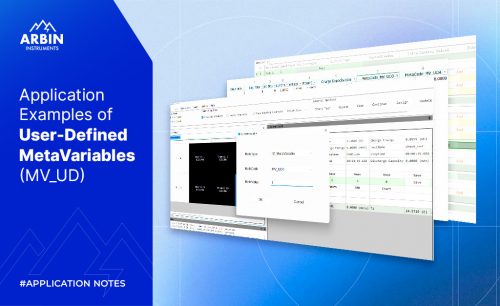
用户自定义元变量(MV_UD)的应用示例
在Arbin软件中,MV_UD(用户自定义元变量)是控制电池测试仪的强大工具。本文将介绍如何在Arbin MITS软件中使用MV_UD。使用SetValue(s)在MV_UD中存储值在“控制类型”列表中,选择“SetValue(s)”。SetValue(s)将某个物理量在特定时刻的固定值赋给 […]
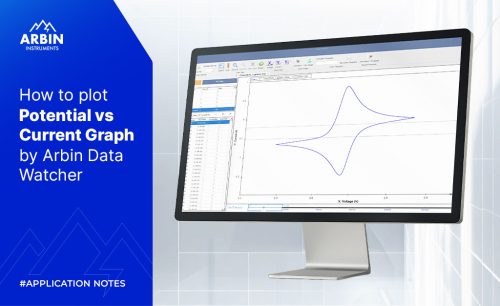
如何使用Arbin Data Watcher绘制电位-电流图
1. 引言 1.1 背景 Arbin DataWatcher 主要用作实时数据分析和可视化工具。它允许用户高效地监控测试数据、绘制曲线和导出数据文件。它使用户能够可视化和分析电压、电流、容量和时间等关键电化学参数。 1.2 本应用笔记的目的 [ […]

准确性和精确性:精确度的影响
我们之前的一篇文章探讨了测量精度方面的影响。在本文中,我们将重点转移到电池测试仪精度对电池研究的影响。在许多研究应用中,dV/dt 和 dQ/dV 等参数被广泛使用。这些测量的可靠性在很大程度上取决于 [...] 的精度。
Need a method we haven't covered?
Send us your test plan. An Arbin applications engineer will recommend a system and write the first schedule with you.
