 简体中文
简体中文  English
  한국어
한국어 





I. Introduction
The Galvanostatic Intermittent Titration Technique (GITT) is an electrochemical method commonly used to study ion diffusion behavior and transport kinetics in battery electrode materials.
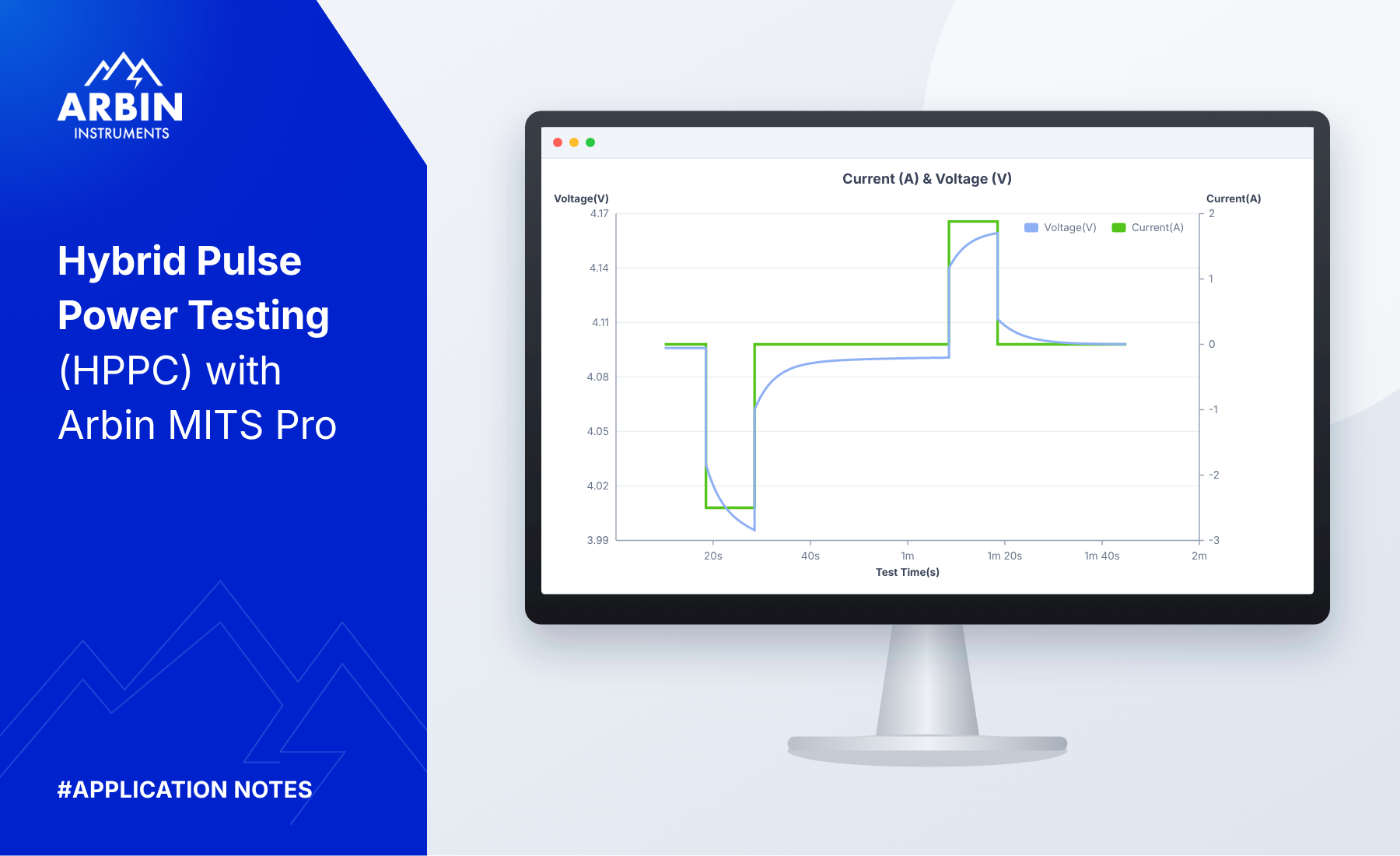
A typical GITT test consists of a sequence of constant-current pulses followed by open-circuit relaxation periods. During each current pulse, the cell voltage changes as the state of charge and concentration distribution within the electrode change. When the current is interrupted, the cell voltage gradually relaxes toward an equilibrium value as the concentration gradients decrease.
By analyzing the voltage response during the current pulse and relaxation period, GITT data can be used to estimate parameters such as the chemical diffusion coefficient and to provide insight into electrode kinetics and thermodynamic behavior.
This application note focuses on how to configure a basic GITT test schedule using Arbin MITS software.
The current amplitude, pulse duration, rest time, voltage limits, and data logging rates shown below are example settings intended to demonstrate schedule configuration. Actual GITT parameters should be selected based on the cell chemistry, electrode characteristics, and experimental objective.
II. Creating a GITT Schedule in Arbin MITS 测试软件
Step 1 — Initial Rest / Voltage Recording
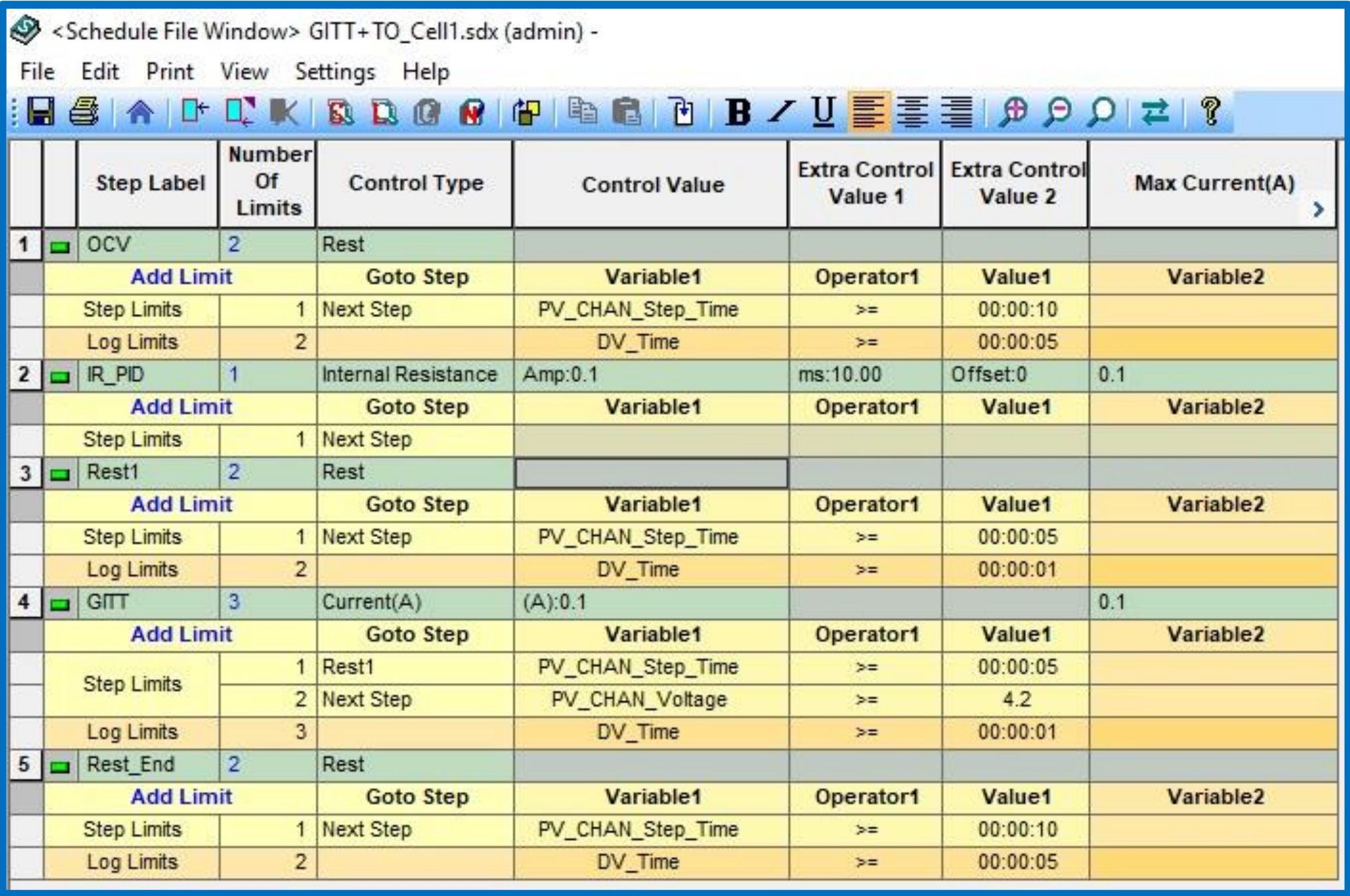
Start the test with a short rest period to record the cell voltage before applying any current.
Example settings:
-
Step duration: 10 s
-
Data logging interval: 5 s
Step 2 — Optional DCIR 测量:
A DC internal resistance measurement may be added before the GITT sequence if resistance information is also required.
A typical DCIR pulse amplitude may be in the range of approximately 0.5C to 2C, depending on the cell and test requirements.
This step is optional and is not required for the GITT measurement itself.
"(《世界人权宣言》) DCIR step terminates and records the measurement automatically according to the configured DCIR settings.
Step 3 — Relaxation Period
This step provides an open-circuit rest period between current pulses.
Example settings:
-
Step duration: 5 s
-
Data logging interval: 1 s
After this step is completed, the schedule proceeds to the GITT current pulse in Step 4.
Step 4 — GITT Current Pulse
Apply a constant-current pulse for a defined duration.
In this example:
-
Current amplitude: 100 mA
-
Pulse duration: 5 s
-
Data logging interval: 1 s
After the pulse is completed, the schedule returns to Step 3 for another relaxation period.
The Step 3–Step 4 sequence is repeated until the cell reaches the specified voltage limit.
In this example, Step 4 also terminates if the cell voltage reaches:
4.2 V
Once the voltage limit is reached, the schedule proceeds to the final rest step.
Step 5 — Final Rest / Voltage Recording
After the GITT pulse sequence is completed, the cell is allowed to rest while the voltage is recorded.
Example settings:
-
Step duration: 10 s
-
Data logging interval: 5 s
This completes the test schedule.
III. Important Considerations for GITT Testing
The values used in this example are intended primarily to demonstrate how a GITT-type pulse-and-rest sequence can be programmed in MITS.
For an actual GITT experiment, the current amplitude, pulse duration, and especially the relaxation time should be selected according to the characteristics of the cell and the purpose of the experiment.
The relaxation period should be sufficiently long for the cell voltage to approach an equilibrium or quasi-equilibrium value. Depending on the battery chemistry, electrode material, cell design, and experimental objective, an appropriate GITT relaxation period may be substantially longer than the 5 s example shown here.
Similarly, the current pulse should be selected so that the voltage response is measurable without producing excessive polarization or moving the cell too far from the desired quasi-equilibrium condition.

