한국어
한국어  English
  简体中文
简体中文  Deutsch
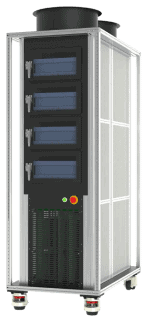








Parallel Differential Battery Testing
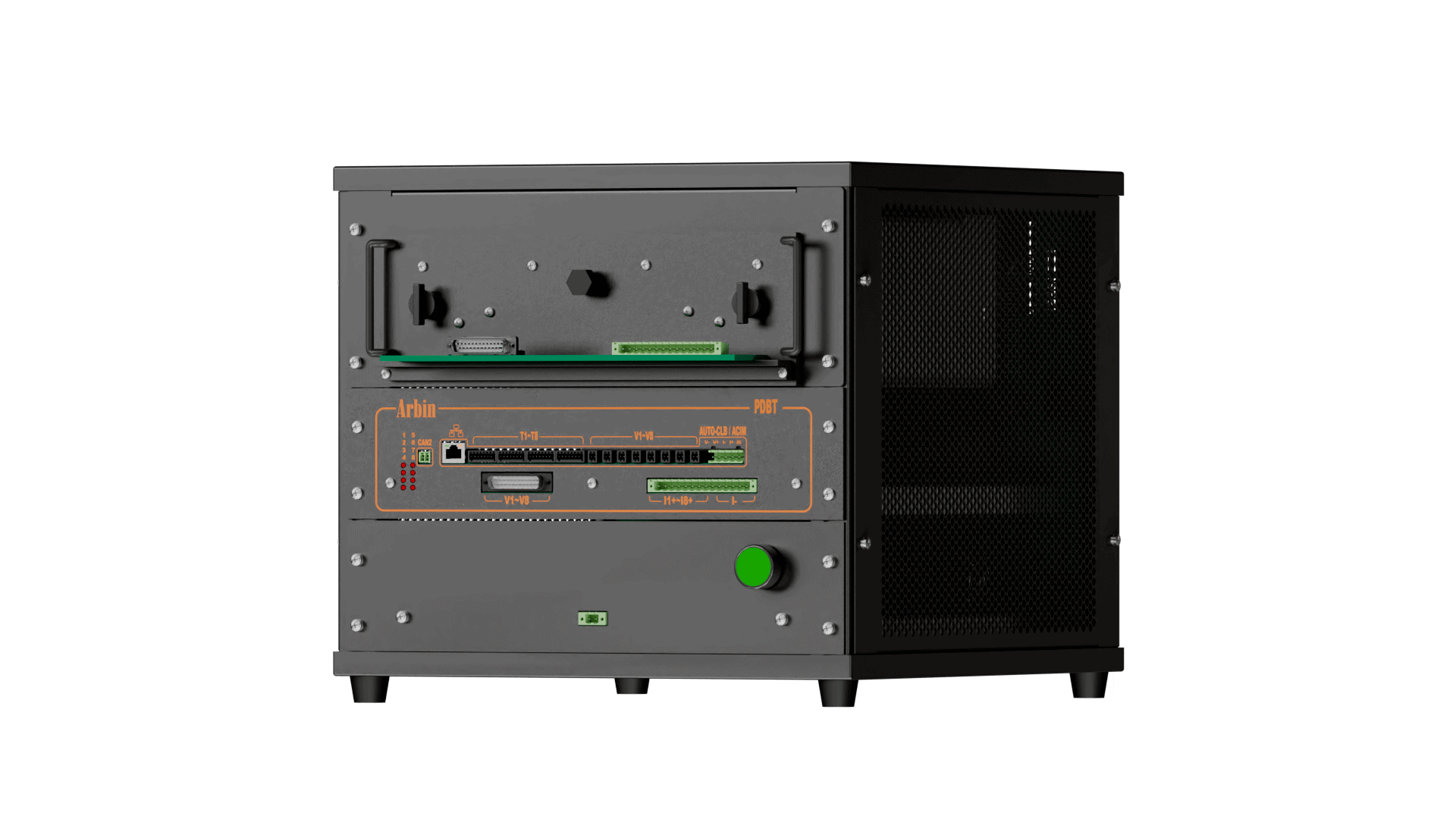
PDBT Benchtop Series
Compare eight cells under the same voltage and thermal condition while measuring the current through every cell independently. PDBT reveals current-sharing differences, accelerates self-discharge measurement, and integrates the cycler, fixtures, and temperature chamber in one compact platform.
8 Cells
One true parallel test group
±0.02% / ±0.015%
FSR accuracy / precision
0–5 V / 5 A
Per-cell channel capability
Integrated chamber
One controlled zone, eight fixtures
Accuracy you can audit
Measurement accuracy held across all voltage and current ranges, with precision published as a separate specification.
Independently verified
Designed and manufactured under an ISO 9001:2015-certified quality system, supported by an ISO/IEC 17025-accredited testing and calibration laboratory.
35 years of instrumentation
Founded 1991. Arbin reinvests 30% of profits into R&D, funding the precision architecture provided with every Arbin test station.
Built for any lab
Scalable channel density in a compact, air-cooled footprint, with open Python and C# API for the automation you already run.
Highlights of the PDBT Series
PDBT changes the electrical relationship between the cells. Instead of running eight isolated tests and comparing the results afterward, it places the cells in a true parallel circuit and measures how each one behaves inside that shared system.
Compare cells under coupled conditions
Eight cells are physically connected in parallel, reproducing the shared-voltage condition that exists inside a parallel group.
See which cell contributes what
Measure the current through every cell independently to expose imbalance, unequal contribution, and current redistribution.
Prepare the group before connection
Automatically pre-charge or discharge individual cells before paralleling so voltage mismatch does not dominate the test start.
Remove a major comparison variable
Test all cells in the same controlled environment with ±0.5°C stability and synchronized thermal and electrical data.
Same voltage does not mean same current
When cells are connected in parallel, terminal voltage is shared—but current contribution is determined by each cell’s capacity, impedance, state of charge, temperature, and dynamic response. PDBT measures those differences directly.
Equalize
Bring each cell to the required starting voltage before establishing the physical parallel connection.
Apply the group load
Control the total current or voltage applied to the parallel group while all cells share one terminal voltage.
Measure every contribution
Record the individual branch current to see imbalance, redistribution, equalization, and cell-to-cell differences.
Test the differences that matter in a parallel group
PDBT adds pack-relevant information to cell research by showing how nominally similar cells interact electrically when voltage is shared.
Comparative cell testing
Compare current contribution, capacity, energy, impedance-related response, and equalization behavior across eight cells in one coupled test.
Self-discharge current measurement
Use the parallel architecture to measure very small self-discharge-related current differences without relying only on long open-circuit voltage decay.
Cell grading and incoming quality
Identify cells that contribute disproportionately or respond differently under common electrical and thermal conditions.
Formation-process validation
Compare cells after formation and aging to determine whether the process produces a consistent population suitable for parallel assembly.
Rate-performance comparison
Evaluate whether cell-to-cell differences become more pronounced as group current and electrochemical demand increase.
Current redistribution and equalization
Observe how individual cell currents change during group operation and after the applied charge or discharge step ends.
Nominally similar cells do not contribute equally
In Arbin’s PDBT technical study, eight Li∥LFP coin cells were tested under a shared voltage. The system captured measurable differences in current contribution, capacity, energy, impedance-related behavior, and post-discharge equalization.
- Differences became more visible as test rate increased.
- Cells sharing the same terminal voltage carried different currents.
- Individual current changed throughout the group discharge.
- Current continued to redistribute as cells equalized after the applied load ended.
- Parallel testing added interaction data that isolated cycling alone could not provide.
One integrated platform for eight-cell parallel testing
The standard PDBT configuration combines four-range cell channels, the parallel differential measurement architecture, fixtures, and environmental control in a compact benchtop chassis.
| Category | Parameter | PDBT Specification |
|---|---|---|
| Electrical | Cell group / channels | 8 cells / 8 individually measured branches |
| Voltage range | 0–5 V | |
| Current ranges per channel | 5 A / 1 A / 10 mA / 1 mA | |
| Combined parallel current | Up to 40 A | |
| 현재 상승 시간 | <100 µs | |
| 측정 방법 | 정확성 | ±0.02% FSR |
| 정밀도 | ±0.015% FSR | |
| Measurement / control resolution | 24-bit / 16-bit | |
| Data acquisition rate | Up to 1 kHz | |
| 통합 챔버 | Chamber arrangement | 1 controlled zone with 8 cell fixtures |
| Temperature range | Ambient −10°C to 60°C | |
| Temperature uniformity | ±1.5°C | |
| Temperature stability | ±0.5°C | |
| Chassis | Size | 16 × 17 × 16 in. (W × D × H) |
| Input power | 110–240 VAC, single phase | |
| 냉각 | Built-in variable-speed air cooling |
Standard tray options support cylindrical 18650/21700 cells and coin cells. Confirm the required cell format and fixture with Arbin when configuring the system.
Comparing systems?
The defining question is not simply how many cells can be connected. It is whether the tester creates a real parallel circuit and measures what each cell does inside it.
| Parameter | Why it matters | PDBT | Ask any vendor |
|---|---|---|---|
| Electrical topology | Eight synchronized independent channels are not electrically equivalent to eight cells sharing one physical voltage bus. | True cell parallelingCells are physically paralleled rather than merely running the same schedule. | Are the batteries truly connected in parallel during the test? |
| Individual branch current | Total group current alone cannot identify which cell is over-contributing, under-contributing, or receiving equalization current. | Measured on every cellEach branch current is recorded independently while group voltage is shared. | Can I see the current through every cell—not only total current? |
| Connection equalization | Directly paralleling cells at different voltages can create uncontrolled transient current before the actual test begins. | Automatic preparationIndividual pre-charge/discharge brings cells to the required starting voltage. | How are cells safely equalized before the parallel connection closes? |
| Thermal consistency | Temperature changes impedance and therefore changes how current divides among parallel cells. | Integrated chamberEight fixtures share one controlled thermal zone with ±0.5°C stability. | Are every cell and every current measurement made under the same controlled thermal condition? |
Software and Safety
The two questions a lab asks after the specifications check out: can my team actually drive it, and what happens when a cell misbehaves.
MITS 소프트웨어
MITS scales from basic charge–discharge cycling to complex protocols with nested conditions. Most tests can be built through the menu-driven interface, while Lua scripting and ArbinCTI are available for advanced automation and external control
- ✓ 30+ programmable control types, 90+ meta variables, and up to 9 nested loops
- ✓Up to 127 reusable sub-schedules, so a validated procedure gets called rather than rebuilt
- ✓Adaptive logging raises acquisition rate during transients and state transitions
- ✓DataWatcher queries the SQL database directly — filter by channel, barcode, or cycle count, overlay up to 9 plots
- ✓PostgreSQL, Microsoft SQL Server, and Apache Kafka streaming
- ✓ArbinCTI TCP/IP API plus Lua scripting for BMS emulation and adaptive control

Safety Architecture
Protection is distributed across channel hardware, an independent controller, and step-level software limits. Critical safeguards remain active independently of the test sequence.
- ✓Independent safety monitoring checks voltage, current, and temperature limits without relying on the test control loop
- ✓Hardware E-Stop with all-pole disconnection, plus a dry-contact circuit for facility-wide remote trip
- ✓Hardware voltage clamps on high-current modules; protective fuses in every I/V channel board
- ✓Test Object profiles auto-set thresholds from the cell spec and block a test on reverse polarity
- ✓Behavioral checks flag abnormal rates, voltage excursions, and capacity anomalies
- ✓Tri-color light tower, audible alarms, thermoswitches, variable-speed ventilation


PDBT or an independent-channel cycler?
The systems answer different questions. Choose PDBT when interaction inside a parallel group is the subject of the test; choose LBTS-Cell when each cell must be controlled independently.
PDBT
Physically parallels up to eight cells at a shared voltage while measuring each cell’s current contribution.
- Shared terminal voltage
- Individual branch-current measurement
- Automatic equalization
- Integrated eight-fixture chamber
- Self-discharge current measurement
LBTS-Cell
Controls each cell independently for characterization, cycle-life testing, electrochemical methods, and flexible research workflows.
- Different schedule on every channel
- Wider range of current configurations
- Independent safety and termination
- Flexible channel and chassis counts
- Broad electrochemical test methods
Tell us what you're testing
Share your cell format, voltage and current requirements, channel count, and test objectives. An Arbin sales engineer will recommend the appropriate system configuration and supporting options.
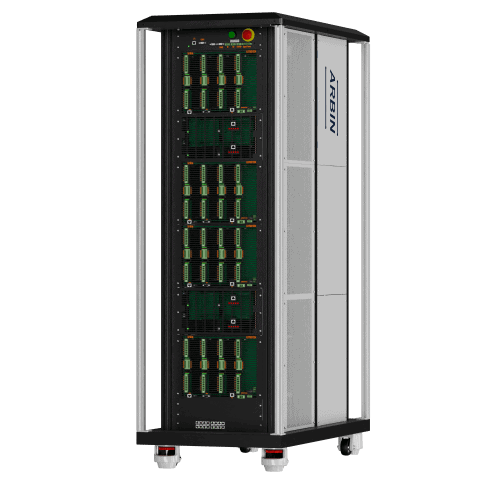
LBTS-Cell
Full range of cell testing solutions from 1A up to 500A per channel using Arbin's high precision LBT hardware