 한국어
 English
 简体中文

Start here
Four notes most engineers read first.
All application notes

Cycle Life Testing to 80% State of Health
How to program a cycle life test in Arbin MITS 11 that measures the reference capacity, calculates state of health after every cycle, and ends automatically at 80% SoH. Full 11-step schedule.
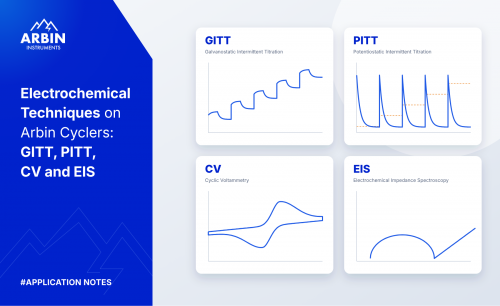
Electrochemical Techniques for Battery Research
What GITT, PITT, cyclic voltammetry and EIS each apply, measure and reveal, and the cycler specifications that decide the result.
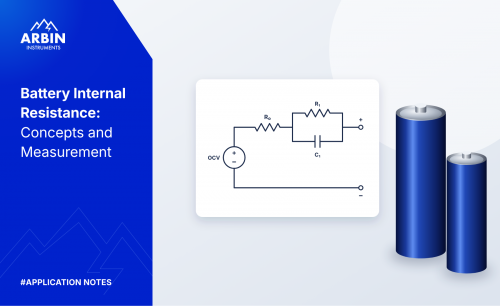
What Is Battery Internal Resistance?
What internal resistance is made of, how ACIR, DCIR and R₀ differ, and how to measure them on Arbin systems.

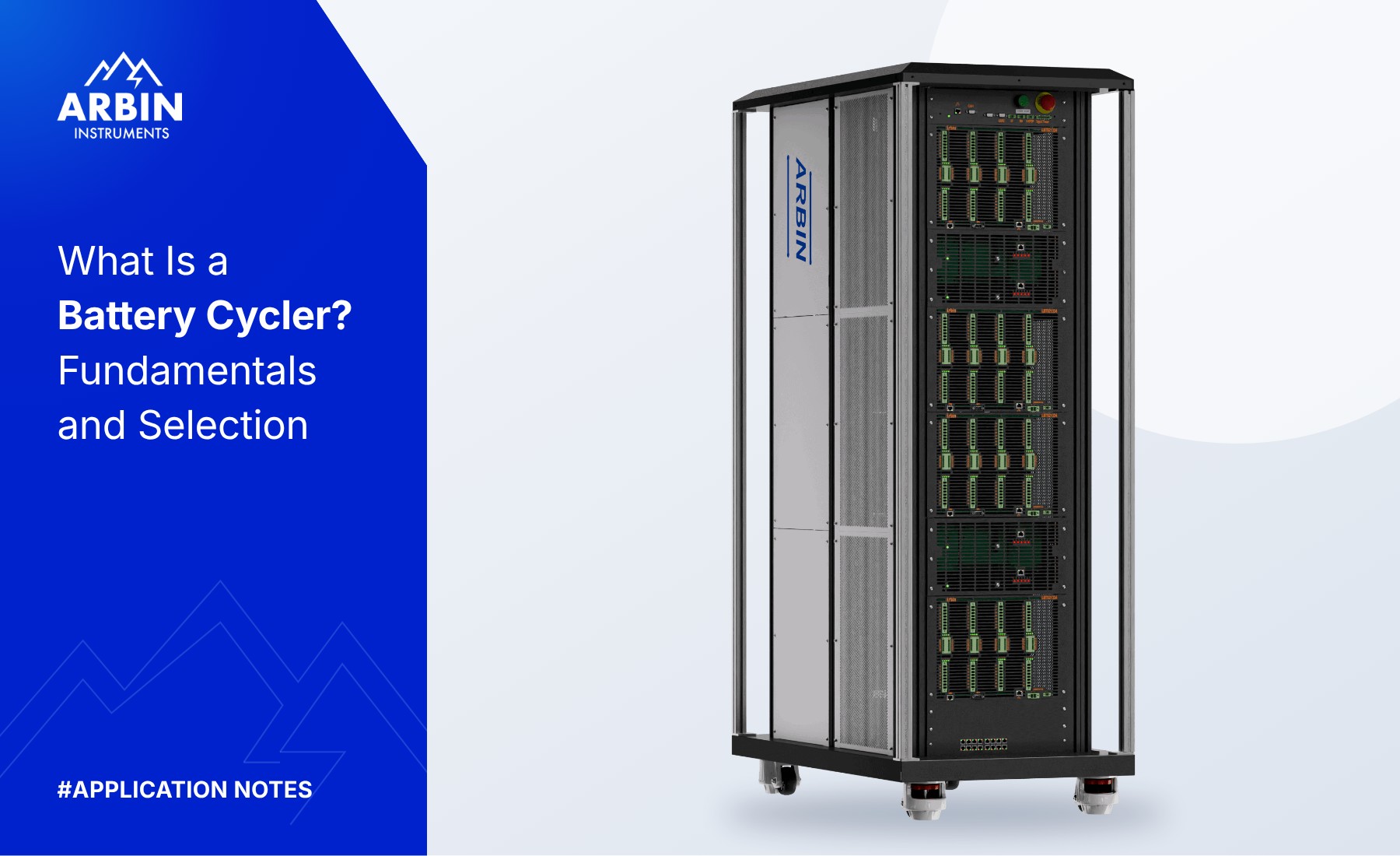
What Is a Battery Cycler?
How a battery cycler works, the specifications that decide data quality, and how to choose a cell testing system.

Battery Cell Grading and Matching: Why Measurement Precision Determines Pack Performance
Home › Resources › Application Notes › Cell Grading & Matching Application Note AN-025 Battery Cell Grading and Matching: Why Measurement Precision Determines Pack Performance Summary A battery pack is only as good as its weakest cell. In a series string, charging stops when the first cell reaches its upper voltage limit and discharging stops […]
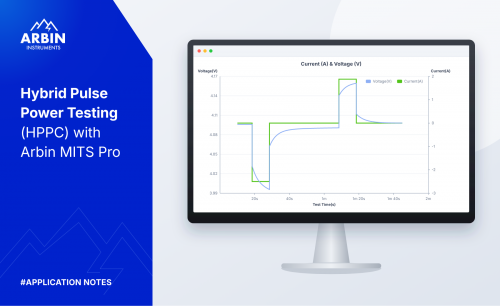
Hybrid Pulse Power Characterization (HPPC) Testing with Arbin MITS Pro
Home › Resources › Application Notes › HPPC Application Note AN-024 Hybrid Pulse Power Characterization (HPPC) Testing with Arbin MITS Pro Summary The Hybrid Pulse Power Characterization (HPPC) test measures the pulse resistance and pulse power capability of a battery across its state-of-charge (SOC) range. This application note describes the HPPC method, the cycler characteristics […]
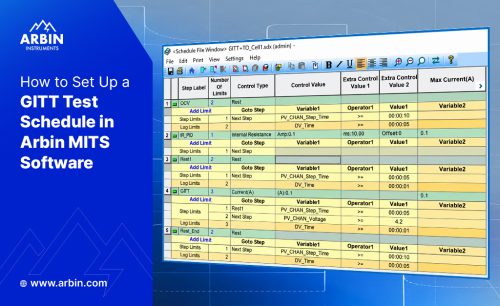
How to Set Up a GITT Test Schedule in Arbin MITS Software
I. Introduction The Galvanostatic Intermittent Titration Technique (GITT) is an electrochemical method commonly used to study ion diffusion behavior and transport kinetics in battery electrode materials. A typical GITT test consists of a sequence of constant-current pulses followed by open-circuit relaxation periods. During each current pulse, the cell voltage changes as the state of charge […]
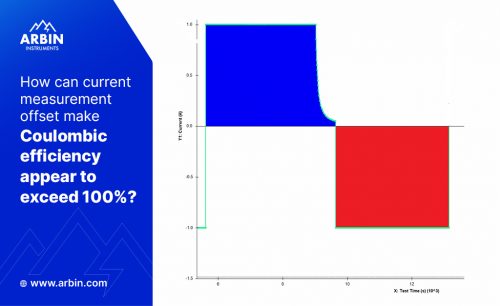
How Can Current Measurement Offset Make Coulombic Efficiency Appear to Exceed 100%?
One common reason that measured coulombic efficiency (CE) can appear to exceed 100% is a current measurement offset. In this example, assume the cycler has a constant negative current offset e. This means the measured current is lower than the true current by e throughout the test. To simplify the analysis, assume an ideal battery […]

Run the cycling test until the capacity decreases to 80% of original capacity
A common end-of-life criterion for lithium-ion cells is when the measured discharge capacity falls to 80% of its initial value. This document demonstrates how to configure an Arbin test schedule to automatically cycle a cell until this threshold is reached. Overall test procedure: Initial capacity measurement → Cycling loop → Compare capacity to 80% → […]

사용자 정의 메타변수 (MV_UD)의 응용 예
Arbin 소프트웨어에서 MV_UD(사용자 정의 메타 변수)는 배터리 테스터를 제어하는 강력한 도구입니다. 이 문서는 Arbin MITS 소프트웨어에서 MV_UD를 사용하는 방법을 설명합니다. SetValue(s)를 사용하여 MV_UD에 값 저장 Control Type 목록에서 SetValue(s)를 선택합니다. SetValue(s)는 특정 순간에 물리량의 고정된 값을 할당합니다.

Arbin Data Watcher에서 전위 대 전류 그래프를 그리는 방법
1. 소개 1.1 배경 Arbin DataWatcher는 주로 실시간 데이터 분석 및 시각화 도구로 사용됩니다. 사용자는 테스트 데이터를 모니터링하고, 곡선을 플로팅하며, 데이터 파일을 효율적으로 내보낼 수 있습니다. 사용자는 전압, 전류, 용량, 시간과 같은 주요 전기화학 매개변수를 시각화하고 분석할 수 있습니다. 1.2 본 애플리케이션 노트의 목적 이 […]

정확도와 정밀도: 정밀도의 영향
이전 글에서 측정 정확도가 미치는 영향에 대해 살펴보았습니다. 이번 글에서는 배터리 연구에서 배터리 테스터의 정밀도가 미치는 영향에 초점을 맞춥니다. 많은 연구 응용 분야에서는 dV/dt 및 dQ/dV와 같은 매개변수가 널리 사용됩니다. 이러한 측정의 신뢰성은 [...]의 정밀도에 크게 좌우됩니다.
Need a method we haven't covered?
Send us your test plan. An Arbin applications engineer will recommend a system and write the first schedule with you.
