 한국어
 English
 简体中文



자주 묻는 질문
What is calibration interval?
Short answer: A calibration interval is the planned time between two calibrations of an instrument. In other words, it’s how long you can rely on the last calibration before the system needs to be calibrated again. For Arbin battery test systems, Arbin recommends a 12-month (annual) calibration interval. Why does the calibration interval matter? All […]
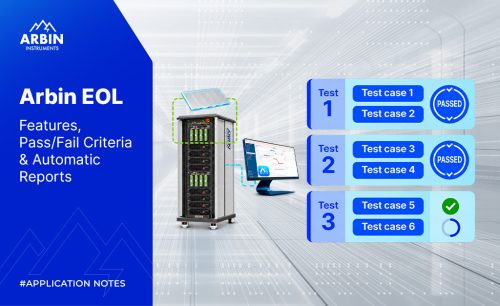
Arbin EOL: Features, Pass/Fail Criteria & Automatic Reports
Arbin End-of-Line (EOL) – FAQ What is Arbin EOL? It’s an end-of-line testing feature built into Arbin’s MITS software. You use it to run pass/fail checks on batteries at the final stage of production. What can it do? Custom pass/fail criteria: You write your own rules with logical expressions and equations, using AND/OR conditions (“Whens” […]
What is the maximum data logging rate an Arbin system can handle? What about Burst Mode?
The logging speed depends on the product series and on how many channels you run at the same time. With a single channel running, Arbin systems can log at up to 1 kHz (1 ms per point) in normal mode. The more channels run at once, the lower the rate per channel, typically a few […]
What can be included in the export file? EIS data? Statistics? Coulombic efficiency?
Short answer: Every export includes the basic time-series data for the DUT: current, voltage, power, capacity and energy at each logged point. You can add more using the checkboxes in the Export window. These include cycle and step statistics (with Coulombic efficiency), the schedule, auxiliary data such as temperature, BMS data, extended variables such as […]

What file formats can Arbin export? What if I don’t have Excel?
Arbin can export data as excel or csv file. Short answer: Arbin can export test data as an Excel file (.xlsx) or a CSV file (.csv). If Excel isn’t installed on your computer, export as CSV and open it with a free program such as LibreOffice Calc. Which format should I choose? Format Best for […]
What to do if the MITS Monitor & Control window freezes while the machine is still running
You can close the Monitor & Control window and reopen it. The Windaq in MITS 10 and DAQ window in MITS 8 are the core of the software. Monitor and control window is only the UI. Short answer Close the frozen Monitor & Control window and open it again. The machine and the test keep […]
Will the formula be locked if the schedule using it is running
Yes — in both MITS8 and MITS10, formulas are part of the schedule. And this isn’t limited to formulas: other library items such as Pulse, Cyclic Voltammetry, and Test Settings also cannot be changed while a schedule is running. Once a schedule starts, only a very limited set of its elements can be modified. Examples […]
What is Pulse in Arbin Library
What is a Pulse step? A Pulse applies a rapid sequence of current steps, each held for a set time in milliseconds, producing a square-wave load instead of a steady one. It is used for short-duration, high-rate testing — internal resistance (DCIR) measurement, pulse-power characterization, and simulating the bursty current draw of real devices. How […]
What is Cyclic Voltammetry and how to use it in Arbin software
Cyclic Voltammetry sweeps a potential (or current) linearly between set limits at a fixed scan rate, then reverses it to form a complete cycle. It’s used to study redox reactions, kinetics, and the electrochemical behavior of materials. In Arbin, a CV routine is defined at two levels: CV level: identifier (CV Label), number of sweep […]
What is Arbin Test setting
Test Settings Test Settings is a feature in Arbin’s MITS software that lets you control peripheral hardware — third-party temperature chambers, digital output (DO), and analog outputs (AO) — directly from the test schedule. Use it to: Set the target temperature on a temperature chamber Set target pressure and humidity on a pressure/humidity chamber Send […]
What are Formula and Advanced Formula in Arbin Software?
Arbin Software lets you control a test with variables instead of fixed values. For example, rather than entering 4.2 V as a control value, you can set the next step’s control type to Last Step Maximum Voltage. These variables can also be combined into formulas that drive the test. For example, you can define FORMULA […]
Can you share Arbin’s warranty policy, including what it covers and excludes?
Please see details in this following links: Arbin Instruments Standard Limited Warranty | Arbin Instruments
